Texas Divorce Papers: Every Form Your Uncontested Case Needs
Key facts: Texas divorce papers
- The forms are free. Every paper named on this page is published at no charge by TexasLawHelp, the self-help site Texas courts point unrepresented filers to. Nobody has to buy a Texas divorce form.
- The core packet is six or seven documents. The Original Petition, the Civil Case Information Sheet, the VS-165, one route into the case for your spouse, one route to finish the case, and the Final Decree the judge signs.
- Texas splits the petition into lettered sets. Set A or D for couples with no children under 18, Set B for couples with children. Filing the wrong set is the single most common reason a self-filed packet comes back.
- Court filing fees run $250 to $350, set by the county and paid to the district clerk, separate from the forms and waivable for filers who qualify.
- What a service like FormsPal sells is completion, not the forms. A one-time $69 (DIY) or $199 (Full Support) fee turns your answers into the filled official PDFs, consistent across every page. Court fees are always paid straight to the court.
Search for "divorce papers Texas" and most of what comes back reads like the paperwork is a product sold by whoever built the fastest landing page. It isn't. Every document a Texas court expects to see in an uncontested divorce is a public form, published by TexasLawHelp, and downloadable for nothing. What actually stalls a self-filed case is rarely the price of the paper, it's picking the right forms for a specific household and keeping the same names, dates, and county spelled the same way on every page.
This guide names the real Texas divorce papers an agreed case files, in what order, and where each one comes from. For the money side, see our Texas divorce cost breakdown, and for the filing mechanics themselves, our Texas filing guide.
The core papers, form by form
An uncontested Texas divorce with no unusual complications runs on a short stack of documents. Six of them apply to every case, and a seventh is required but comes in two forms depending on how cooperative the other spouse is willing to be.
| Document | Form code | What it does |
|---|---|---|
| Original Petition for Divorce | FM-DivA/B/D-100 | Opens the case. States residency, the grounds, and what you're asking for. |
| Civil Case Information Sheet | PR-Gen-116 | Statewide cover sheet filed with the petition, routes the case inside the courthouse. |
| Information on Suit Affecting the Family Relationship | VS-165 | Reports the divorce to Texas Vital Statistics. Required for every case, children or not. |
| Waiver of Service or Original Answer | FM-DivA/B-103 / -102 | Brings the other spouse into the case without formal service, if they're willing. |
| Sample Testimony or Prove-Up Affidavit | FM-DivA/B-Test / -600/601 | Finishes the case: a short spoken hearing or a sworn affidavit, depending on the court. |
| Final Decree of Divorce | FM-DivA/B/D-201 | What the judge signs. Ends the marriage and states the full property division. |
Every one of these ships as a real, fillable Texas divorce form PDF, not a scanned image you're expected to print and hand-letter. TexasLawHelp's PDFs open in any reader, and the fields tab in the same order a clerk reads the page, which matters more than it sounds like once you're four forms deep and trying to keep a county name spelled the same way on all of them.
Form codes and requirements: TexasLawHelp's no-children divorce guide and its with-children guide. TexasLawHelp is the self-help legal site the Texas courts and the State Bar direct unrepresented filers to, and its forms are free Texas divorce forms in the plain sense of the phrase: no purchase required, no account needed, downloadable as a PDF the day you decide to look.
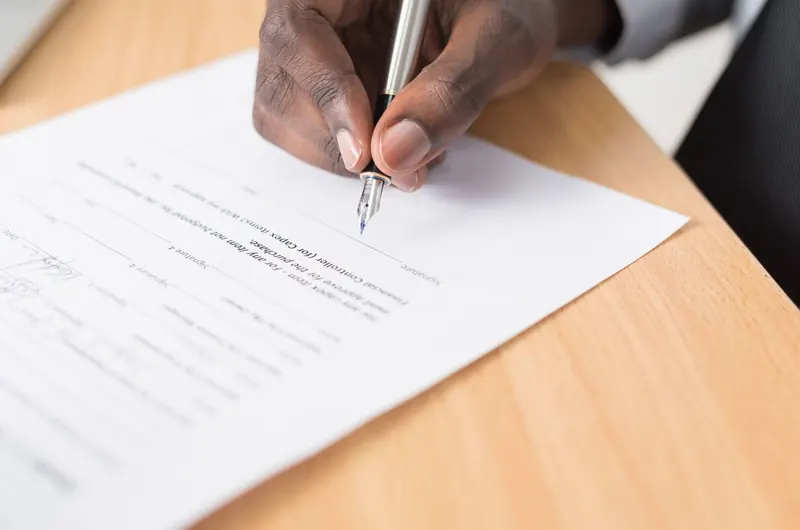
Two lines in that table hide a decision, not an extra document. A case uses a Waiver of Service or an Answer or formal service by a constable, never more than one. And it closes with a spoken prove-up or a notarized affidavit, whichever your particular court accepts, not both. Everything else on the list is genuinely required, every time.
Set A, Set B, or Set D: TexasLawHelp's lettered sets
TexasLawHelp doesn't publish one generic Texas divorce packet. It organizes uncontested cases into lettered sets, and the set decides which version of the petition and the decree a case files.
| Set | Who files it | What's different |
|---|---|---|
| Set A | No children under 18, no real property | The shortest petition and decree, spouses and property division only. |
| Set D | No children under 18, real property (a house, land) | Adds the language that actually divests and vests title, rather than only pointing at a separate agreement. |
| Set B | Children under 18 together | Adds conservatorship, a possession schedule, support terms, and a pregnancy question. |
Picking wrong is the single most common mistake in a self-filed Texas case: a couple with a house grabs the Set A forms because they have no kids, and the decree that comes back has nowhere to actually transfer the deed. Or a couple files Set A and only later realizes real property belongs in Set D. The children question sorts A/D from B. The property question sorts A from D. A case only ever needs one petition and one decree, matched to both answers.
The Original Petition for Divorce, closely
The petition is the one document a case cannot start without, so it earns a closer look than the rest of the packet. Filed with the district clerk, it is what legally opens the case and sets the 60-day clock running under Tex. Fam. Code Section 6.702.
Inside, the petition pleads four things. First, residency: that one spouse has lived in Texas for at least six months and in the filing county for at least 90 days, the threshold set by Tex. Fam. Code Section 6.301. Second, the grounds, almost always insupportability, Texas's no-fault ground, meaning the marriage has become insupportable because of discord with no reasonable expectation of reconciliation. Third, the marriage and separation dates, which anchor everything that follows. Fourth, in general terms, how the community property and debts are being asked to be divided, and where there are children under 18, what's being asked on conservatorship, possession, and support.
Once filed, the spouse named as Respondent has to be brought into the case somehow. That's either formal service by a constable or private process server, or the cooperative routes covered next. Filing first doesn't give the Petitioner more say over the outcome. It only decides whose name opens the cause number.
The petition ships in two forms depending on children, covered in the set breakdown above, and the current with-children version is published directly by TexasLawHelp as Set B.
Getting your spouse into the case
An agreed divorce still has to satisfy the court that the Respondent knows the case exists. Texas gives cooperative spouses two ways to do that without a process server.
The Waiver of Service Only is the simpler route: the other spouse signs a form in front of a notary saying they've received the petition and don't need to be formally served. The timing rule catches people constantly: Tex. Fam. Code Section 6.4035 requires the waiver to be signed at least one day after the petition is filed, not the same day, and definitely not before. A waiver signed too early gets rejected and has to be redone.
The Original Answer is the alternative. Instead of waiving service, the Respondent files a short answer of their own, which brings them into the case on the record without a notary and without a waiting-a-day rule. A case uses one route or the other, never both, and if neither happens, formal service is the fallback.
If you have children together
Children under 18 change the petition and decree to Set B and add a handful of papers on top of the core packet: a Standard Possession Order that sets the schedule for time with each parent, an Income Withholding Order for support, and a Record of Support Order filed with the state child support registry. If a parent or the children live outside Texas, an Out-of-State Party Declaration goes in as well. The VS-165 also gains a children's section that the no-children version skips. For the full breakdown of what changes and why, see our guide to a Texas divorce with children.
Two more papers show up only when a specific fact calls for them, and neither is part of the core packet. An Order Restoring Name Used Before Marriage lets a spouse reclaim a former name inside the divorce itself, free, instead of filing a separate name-change case afterward, so it's worth asking for if it applies to you. A Qualified Domestic Relations Order divides a 401(k) or a pension, and TexasLawHelp doesn't publish one, because a QDRO has to be written to match each retirement plan's own rules. Where a case involves splitting retirement accounts, that order is typically drafted separately from the rest of the packet.
The filing fee and the fee waiver
Texas divorce forms cost nothing. Filing them does not. The district clerk in the county where you file sets its own fee, most commonly somewhere in the $250 to $350 range, with a service charge on top if a constable delivers the papers. There's no statewide schedule the way some states run one, so the number your specific county charges is the one that matters, and it's worth confirming directly with that clerk's office before you file.
Filers who can't cover that get a real out: the Statement of Inability to Afford Payment of Court Costs, a sworn form that asks a judge to waive the filing fee based on income, benefits, or hardship. It's free to file in its own right, and where a case's answers suggest someone may qualify, FormsPal prepares it as part of the packet. For the fuller cost picture, including attorney rates for cases that don't fit the agreed path, see our Texas divorce cost guide or run the divorce cost calculator with Texas preselected.
How the papers actually reach the court
The petition, the Civil Case Information Sheet, and the VS-165 go to the district clerk together, in person, by mail, or through eFileTexas.gov, which is optional for filers without a lawyer and mandatory for attorneys. The clerk stamps them in and assigns a cause number. From there, the Waiver or Answer follows, the 60-day period runs, and the prove-up and Final Decree close the case out once that period has passed. Our Texas filing guide walks through each stage in county-level detail, including what to expect from the specific district clerk's office you'll be dealing with.
Blank forms or prepared forms
It's worth saying plainly: filling out the Texas divorce papers yourself, for free, is a legitimate way to get divorced. Texas courts expect people to represent themselves, the forms come with written instructions, and nothing about doing it by hand disqualifies a case. The trade is your own time against the risk of a clerk sending something back over a mismatched date or a missing companion page.
What a service like FormsPal sells isn't access to the forms, since access was never the problem. It's turning one set of answers into the correctly chosen, correctly filled official PDFs, with every name, date, and county consistent across the whole packet, plus filing steps for your specific county. That's a one-time $69 for the do-it-yourself tier or $199 for Full Support, on top of the court's own filing fee, which is always paid to the court and never to us. For a walk through what an agreed case actually looks like start to finish, see our uncontested Texas divorce guide.

If your case is contested, meaning you and your spouse can't agree on the children, the property, or support, this packet and this kind of service stop being the right tool. A contested case is decided by a judge over disagreement, and a family law attorney protects interests that a self-help form, filled by anyone, cannot. The honest version of this guide only points the free and paid paperwork routes at agreed cases, because that's what they're both built for.
Frequently asked questions
Are Texas divorce forms really free?
Yes. TexasLawHelp, the self-help legal site the Texas courts and the State Bar point unrepresented filers to, publishes every form named on this page at no charge. You can download the Original Petition, the Civil Case Information Sheet, the VS-165, and the Final Decree today without an account or a payment. What costs money is the court's own filing fee, and optionally, having the forms filled out for you.
What is the Original Petition for Divorce?
It is the document that opens a Texas divorce case. Filed with the district clerk, it pleads residency, states the grounds (almost always insupportability), gives the marriage and separation dates, and covers property, debts, and any children. Filing it starts the 60-day waiting period Texas law requires before a judge can sign the Final Decree.
How do I know if I need Set A, Set B, or Set D?
The children question sorts the sets first. No children under 18 means Set A or Set D. Children together means Set B, which adds conservatorship, a possession schedule, and support terms. Between Set A and Set D, real property such as a house or land moves a no-children case to Set D, which carries the language needed to actually transfer title.
What is the difference between the Waiver of Service and the Answer?
Both bring a cooperative spouse into the case without a process server. A Waiver of Service is signed before a notary and, by Texas law, at least one day after the petition is filed. An Answer is a short document the responding spouse files instead, on the record, with no notary and no one-day rule. A case uses one or the other, not both.
Do I need a lawyer to file Texas divorce papers myself?
No. Texas courts expect people to represent themselves in an agreed divorce, and every form in this packet ships with written instructions. Filing yourself is a legitimate, legal path. The trade is your own time and attention against the risk that a clerk sends the packet back over a detail that does not match across pages.
How much does it cost to file Texas divorce papers with the court?
The forms themselves are free. Filing them with the district clerk typically costs $250 to $350, set by your county, with a service charge on top if a constable delivers the papers. Filers who cannot afford that can file a Statement of Inability to Afford Payment of Court Costs, a free sworn form asking a judge to waive the fee.
What if my spouse will not sign anything?
Then the Waiver of Service and the Answer are both off the table, and the case moves to formal service by a constable or a private process server instead. If your spouse is actively contesting the divorce rather than simply slow to sign, the case is contested, and a family law attorney, not a self-help packet, is the right next step.